


What started as a typical workday turned into a life-threatening emergency for Michael Petzhold, a truck driver who lives and works in the greater Remscheid area. Although he admits to feeling a bit unwell that morning, there was no indication of an impending emergency when he started his morning shift at a large metal-processing company in Remscheid.
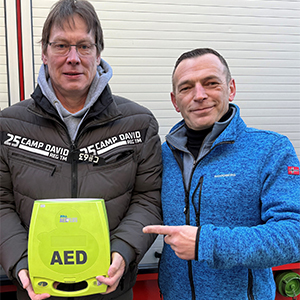
But soon after he started work, Michael’s condition suddenly worsened. He became dizzy, lost consciousness, and fell from his truck. Just seconds later, he was found by a colleague.
First responders were immediately alerted, and by the time they arrived, Michael had already suffered a cardiac arrest. The responders began performing cardiopulmonary resuscitation (CPR) right away and used an automated external defibrillator (AED) to deliver a lifesaving shock even before emergency medical services arrived.
When the emergency medical team reached the scene, responders had successfully resuscitated Michael: although he remained unconscious, a stable heart rhythm had been restored. The emergency team provided additional medical care on site before transporting Michael to a hospital.
Fortunately, Michael’s outcome was positive: He was soon weaned from mechanical ventilation, and he left the hospital about a week later.
This incident powerfully demonstrates the critical importance of rapid, decisive action by lay responders, a well-functioning workplace emergency response system, and early use of an AED.
As Michael’s story shows, layperson resuscitation—accompanied by quick access to an AED—saves lives.